
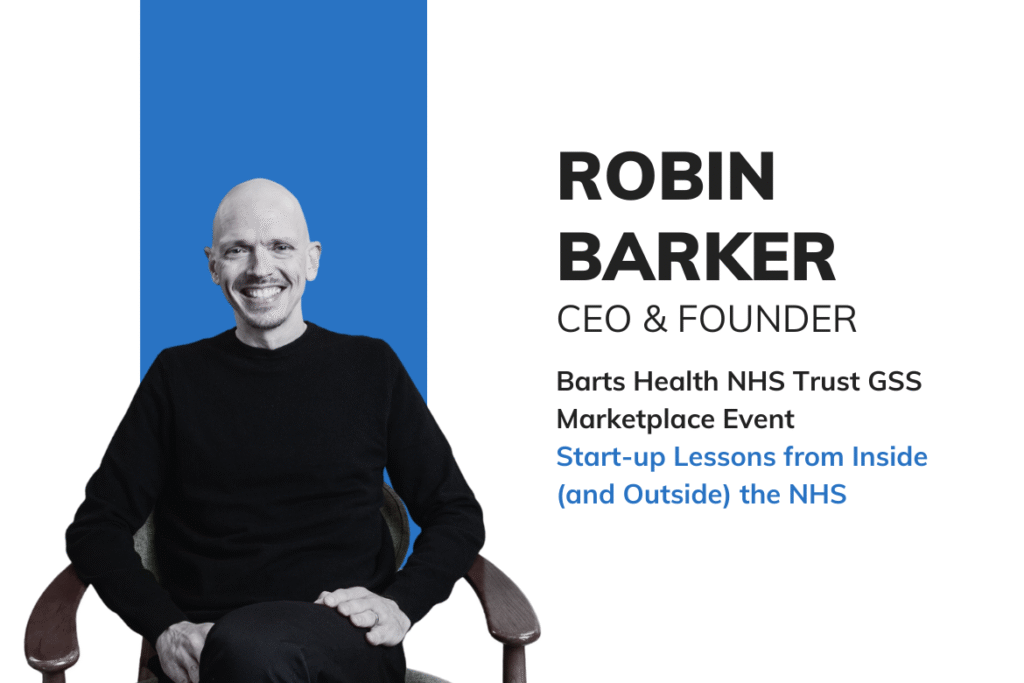
Robin Barker, CEO and founder, We Can Talk
I recently joined Barts Health NHS Trust’s GSS Marketplace event to share lessons from the journey of building We Can Talk — from clinician to company founder. It was great to be part of a lineup featuring Microsoft, Multiverse, and Amazon, all focused on helping NHS teams think differently and work smarter.
But the NHS is unique. Building something inside it—or alongside it—comes with its own rules. Here are three lessons I’ve learned along the way.
🎯 Lesson 1: Get close (to the problem)
— Choose truth over status
Early in my career, I held national advisory roles that felt influential and important. But I was also still working clinically—and I could see directly that too often decisions made in boardrooms didn’t translate to change on the frontline. Consultation isn’t co-production. The further you are from the problem, the more confident (and wrong) you can become. Getting close to the problem means testing your thinking with people who are experiencing the challenges you’re trying to transform—and that requires humility.
Ask yourself:
- Who’s not in the room that should be?
- When was the last time you tested your assumptions with frontline staff or patients?
- What processes exist because “that’s how we do it” vs. because they serve our mission?
🎯 Lesson 2: Start small
— Choose learning over launching
I wasted years trying to find somewhere that would let me begin big. Grand proposals, ambitious pilots—and a lot of rejection. Nobody lets you revolutionise everything at once. So I started smaller: lunchtime conversations, small surveys, early morning training sessions. Building evidence one interaction at a time, until I found my early adopters and my key champion. That eventually led to a pilot with just over 100 staff. Those 100 became the foundation for everything that followed (35,000 staff and counting!). You can’t skip the trust-building phase. Make your idea so small it’s hard to say no to.
Ask yourself:
- How can you build evidence before you build infrastructure?
- What’s the smallest version of your idea you could test?
- Who are your early adopters?
🎯 Lesson 3: Challenge success
— Choose impact over appearance
This is the hardest one. At our peak, we looked successful by every conventional measure—but when I interrogated the data, I realised we were successful without being transformative. We were reaching staff who already wanted to learn, but not always the ones who thought mental health wasn’t their job – the ones we really needed to reach. Those are the staff we designed this for. “It’s working” is the most dangerous phrase when you’re trying to create change. Metrics that make you look good aren’t always metrics that create change. Sometimes you have to break what you’ve built to make it what it should have been.
Ask yourself:
- What works well enough that no one questions it—but doesn’t actually deliver the outcomes patients or staff need?
- Are you measuring what makes you look good or what creates change?
- What would you do differently if you were starting from scratch today?
🧵 The through-line:
- Get close (to the problem): choose truth over status
- Start small: choose learning over launching
- Challenge success: choose impact over appearance
You don’t need permission to try something different. You need to make it too small to stop and too evidence-based to ignore.
What’s the one thing you know needs to change that everyone’s too comfortable to question?
Want to learn more about how We Can Talk is transforming mental health culture in acute hospital settings?
You can email me directly at robin@wecantalk.com
Or use the form below and select: “I want to connect with your team.”